
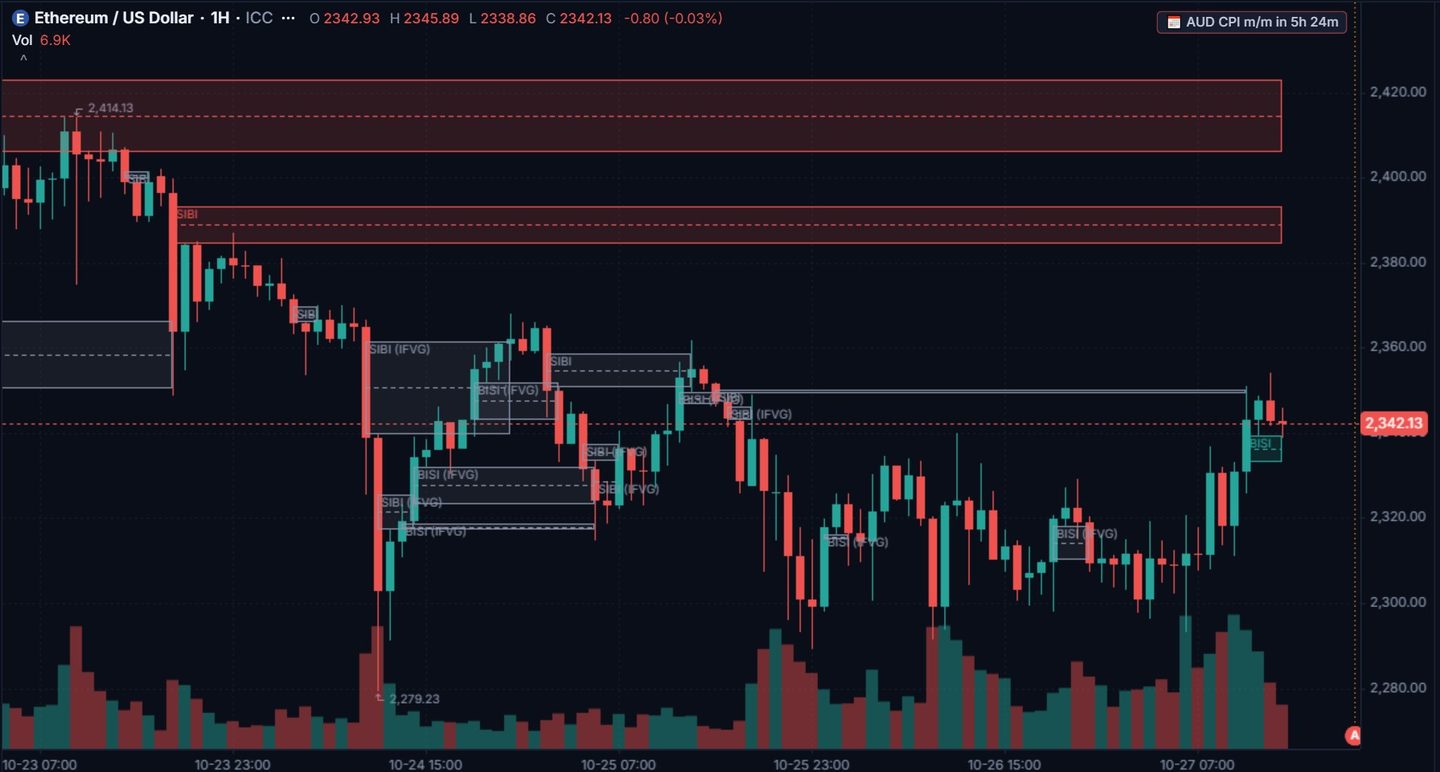
What the chart shows
A fair value gap is a three-candle pattern where the middle candle moved so fast that the first and third candles do not overlap. On this Ethereum chart the fast drop on 23 October left two red SIBI boxes (sell-side imbalance, buy-side inefficiency: a bearish gap) around 2,385 to 2,420. Price has not traded back up into them, so they are still open above the market.
The grey boxes in the middle are gaps that did not hold. When a candle closes through the far side of a gap, the terminal relabels it IFVG (inversion fair value gap): a former bullish gap can then act as resistance and a former bearish gap as support. After the sharp drop to about 2,279 on 24 October, several gaps flipped this way while price chopped between 2,300 and 2,360. On the right, the rally on 27 October left a new teal BISI (a bullish gap) just under price.
The rule in short
- Bullish gap: the first candle's high is below the third candle's low. Bearish: the first candle's low is above the third candle's high.
- The dashed line is the middle of the gap, the consequent encroachment (CE). Price often reacts there.
- A gap that price closes through becomes an IFVG and swaps roles.
What is different on crypto
Crypto produces many small gaps, because candles are large and liquidity is thinner outside the busy hours. Filter them: gaps made by a move that also broke structure, or that sit inside a higher-timeframe order block, carry more weight than a random gap in a quiet hour. Practise spotting them in the free FVG round of the Chart Challenge.
Try it on the chart
Open ETHUSD in ICC Charts, pick the 1h chart and switch on the same layer in the ICT menu. New accounts get the first 14 days free.
Trading a prop firm challenge?
Some prop firms also offer crypto CFDs with daily loss and drawdown limits; size every trade from its stop loss with the crypto position size calculator.
The5%ers Partner link offers funded trading challenges. We may earn a commission if you buy through it. Prop firm challenges are paid evaluations; most traders don't pass. Trade only what you can afford to lose.
Questions
What do BISI and SIBI mean?
BISI is a buy-side imbalance with sell-side inefficiency: a bullish gap. SIBI is the opposite: a bearish gap.
What is an IFVG?
An inversion fair value gap: a gap that price closed through. It often acts in the opposite direction afterwards, so a broken bullish gap can become resistance.
Charts: crypto CFD candles of a broker's MT5 demo feed, shown in the ICC Charts web terminal. ICC Charts is not affiliated with Inner Circle Trader; the lessons explain the concepts in our own words. Crypto trading with leverage carries a high risk of losing money; this is education, not financial advice and not a signal.